
Hey Ritwik Da, where are you off to this Pujo?)’
‘‘Haven’t decided yet… Thinking of scooting off to Purulia, to this place called Mohulban; beautiful place, pet-friendly, I can take Jack along.’
‘‘Pfffft! Purulia! Raja Da is going to the moon.’
‘To the moon? What do you mean? On a trip? How?’
‘Yeah, yeah, boss! Virgin Galctic. He has booked tickets. Takes big bucks, man!’
‘Shoot! Where are things headed, man!’
A couple of decades back, this conversation would have seemed straight out of a Ghona-Da tall tale. Not anymore.
On July 11, 2021, British billionaire Richard Branson boarded his company Virgin Galactic’s Unity 22 flight from the Mojave Desert in New Mexico. He enjoyed over three minutes of weightlessness in microgravity in sub-orbital space and returned – safely – in the vehicle’s first fully crewed test flight to space. It was a symbolic milestone for a venture Branson started 17 years ago.
Not the dude to be left behind, on July 20, 2021 – on the 52nd anniversary of the Apollo 11 moon landing in 1969 – Amazon.com founder Jeff Bezos took off on a flight to space, launching his space tourism company Blue Origin’s New Shepard reusable launch vehicle, with humans aboard. Along with his brother Mark, Wally Funk – an 82-year-old woman aviator who trained as an astronaut back in the 60s but was snubbed the chance to space travel because she was a woman – was on Bezos’ flight, as well as 18-year-old Dutch student Oliver Daemen. The flight was live-streamed on the Blue Origin website.
In December 2021, Japanese billionaire Yasaku Maezawa is set to travel to the International Space Station (ISS) in a Russian Soyuz rocket through the intermediary Space Adventures. Maezawa might travel to the moon in 2023, in a rocket now in development by the company SpaceX.
Not just for multi-billionaires only, a-la Bezos, Elon Musk or good ol’ Branson. As of 2021, there are over 15 ‘agencies’ that now offer space tourism – including Bezos’ Blue Origin and Branson’s Virgin Galactic, through stratospherically-priced auctions, and possibly soon, bookings. And if you think ‘real’ space is a tad bit too expensive, there are other options, as well. At $125,000, the Space Neptune capsule will take you out to the upper atmosphere by a balloon the size of a football stadium. There’s even a pseudo-space tour in a modified Boeing 727, where passengers can experience what it feels like being in space. The company ZERO-G offers parabolic flights — essentially, flights that make you feel weightless – aboard this special Boeing, dubbed ‘G-FORCE ONE’. Not cheap at upwards of $5,000 per person, but still a lot cheaper than the other options — priced at millions of US dollars – and one that can be done immediately.
Not just for multi-billionaires only, a-la Bezos, Elon Musk or good ol’ Branson. As of 2021, there are over 15 ‘agencies’ that now offer space tourism – including Bezos’ Blue Origin and Branson’s Virgin Galactic, through stratospherically-priced auctions, and possibly soon, bookings. And if you think ‘real’ space is a tad bit too expensive, there are other options, as well.
It is quite certain that I am never going to make it to space — simply because I will never be making that kind of money in this lifetime. But in a few years, you and I may come across folks that have booked, travelled and loaded their social media feed with resplendent photos from their space tours. While not exactly your annual pujo trip – and not quite this year – space tourism is scheduled as Abahon, for sure. Pretty soon, millionaire businessmen, CEOs of global conglomerates, sports stars and Hollywood actors might well be on the list to spend a few million greenbacks on a 15-minute arc through sub-orbital space.
The definition of travel, as a human activity, is set to change entirely as man – not astronauts, but people, rich people – reaches for the moon, literally. There’s a set of criteria, of course, apart from big expendable bucks. Bezos’ Blue Origin outlines these with a detailed height and weight requirement (between 5’0” and 50kg and 6’4” and 100kg), and a physical condition where one can climb seven flights of stairs in under 90 seconds.
All of this is a far cry from my first brush with anything space-ey, sometime back in the mid-80s — through Professor Shonku’s incredible tale of space travel in Byomjatrir Diary (‘Diary of a Cosmonaut’). The first Shonku tale by Satyajit Ray, the story outlines how the Giridi-based genius scientist sets off on a mission to Mars, in a rocket entirely of his own design. The indestructible elements of this spaceship? ‘…Byang-er chhata (mushroom), shaap-er kholosh (snakeskin) ar kocchoper dim-er khola (tortoise shell)…’. Certainly a wholesome, ‘organic’ combination, definitely pocket-friendly. We are not certain whether Professor Shonku was ready to take on passengers aboard his rocket — the only ones aboard were his all-Giridi, homemade (or home lab-made) robot Bidhushekhar and cat Newton.
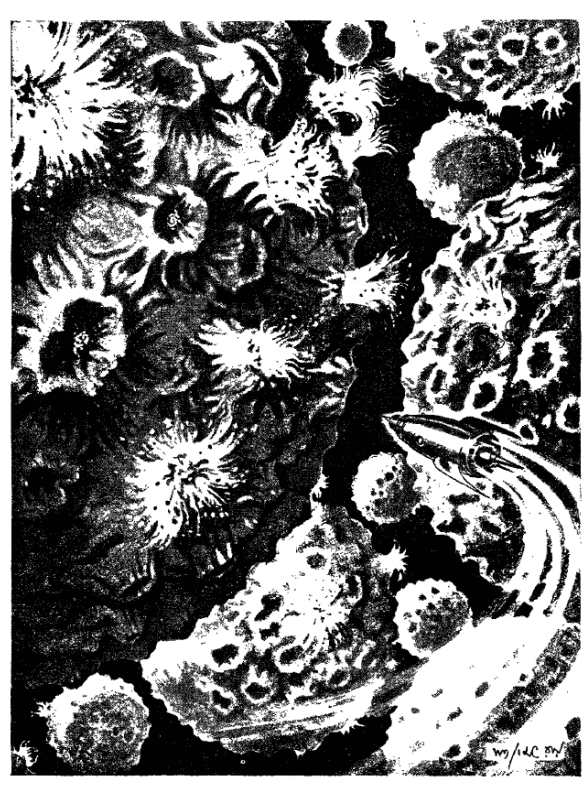

By his own admission, Shonku says he feels ‘… a strange pull towards space… a force exactly opposite to gravity…’. He even outlines the exact day, ‘12 years ago’, when he could pin the seeds of this feeling. He had a life-like dream of a ‘huge, blazing meteor’ that fell on a Goloncho tree on the western corner of his garden as he lounged, post-dinner on a pleasant Ashwin night. Notice the time of the year – Sharatkaal, the month of Ashwin, Pujo du jour. Talk about Abahon!
Themes of the cosmos – and fascinating travels, therein – return to the Shonku canon in Mohakasher Doot and Professor Shonku O U.F.O, though the latter overlaps on to alien spaceship territory.
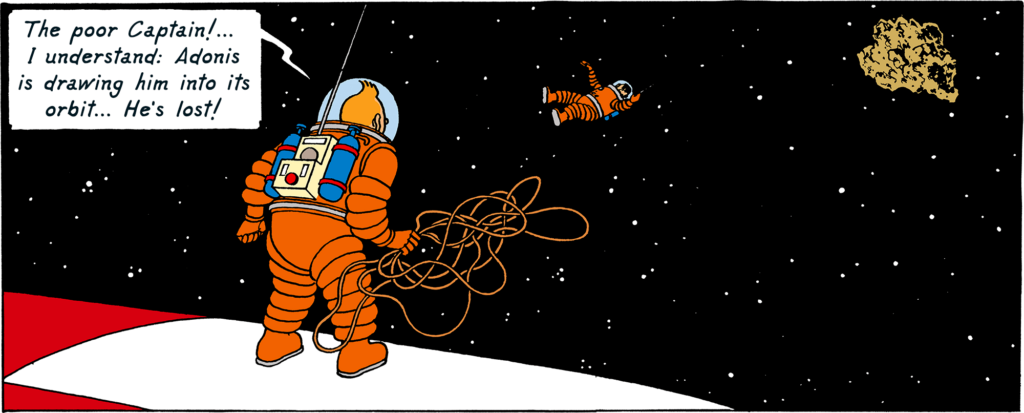
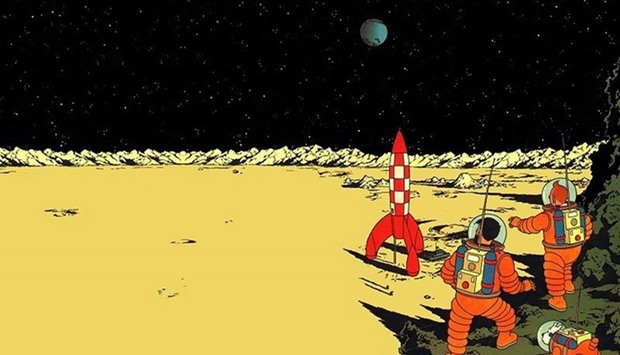
A little older, we were fascinated by Tintin’s twin tales of mankind’s wish to conquer space. It is fascinating to realise that Herge wrote and drew the story of Destination Moon (1950) and two years later, imagined, drafted and published a full-blown story against a backdrop of space in Explorers on The Moon (1952). That he could place his fictional reporter and his dog on the moon 17 years before Neil Armstrong actually set foot on Earth’s lone satellite is a testimonial to his incredible imagination. Ray’s first Shonku tale came in 1961; the celebrated auteur was a huge Tintin fan. In 1956, Isaac Asimov wrote ‘Living Space’. A lifelong proponent of space travel, Sir Arthur C. Clarke co-wrote the screenplay for 2001: A Space Odyssey in the mid-1960s.
It would be interesting to imagine what Herge and Ray, Clarke and Asimov would have thought of mankind’s giant leap into space, one where the word ‘tourism’, in conjunction, is now set to become unremarkable. Abahon it is, but like everything that comes around, let’s hope that space, vast as it is and the mysteries thereof, does not descend into the everyday via these packaged space tours. Let the spirit of adventure remain fresh, please.