
By writing in Italian, I think I am escaping both my failures with regard to English and my success. Italian offers me a very different literary path. As a writer I can demolish myself, I can reconstruct myself. I can join words together and work on sentences without ever being considered an expert,” notes Jhumpa Lahiri in her 2015 essay ‘Teach Yourself Italian’, published in the New York Times. Do we then consider her an expert when she translates her own Italian novel Dove Mi Rovo (2018) into English? Or in this first attempt of translating her own work – is she an Italian writer translating her work into English? Or is she the award-winning author writing in English, a language in which she has written some of her best-known works – Interpreter of Maladies, The Namesake, Unaccustomed Earth and, The Lowland?
For a writer, whose smooth and succinct language skills have won her a Pulitzer Prize, to forego that language completely and decide to take on a new one is a brave decision— one that soars often but also gets stuck in the eddies of sameness at times.
With Whereabouts, Jhumpa Lahiri makes a determined departure from what defined her as a writer when she was writing about the immigrant experience, particularly of Bengalis, in the United States of America. Her protagonist is an unnamed, middle-aged woman living in an unnamed city. The only clues we have that the city she is referring to is in Italy are the trattorias. The choice of form in this rather short work of fiction is 46 compact chapters which resemble fleeting ‘vignettes’– each chapter title describing a distinctive aspect of the narrator’s life or the city she inhabits. ‘In The Piazza’, ‘In The Bookstore’, ‘At The Ticket Counter’ all illustrate the mundane everyday existence of the protagonist in short bursts.
While it may not be as fluid as what one has come to expect from Lahiri, Whereabouts is menacingly haunting. The journey to leave this city that the narrator has called home for her entire life is something that most millennials will find extremely relatable.
None of her acquaintances, friends or the people she encounters in her day-to-day existence have been named – just their mannerisms and characteristics as observed by our narrator. The elderly woman who walks with a limp, the couple who live around the corner, a woman who sweeps the piazza as if it were her own living room. However, each time we get ready to dive into these lives in connection to the narrator’s, there is an abrupt end. The author doesn’t really delve into these personalities – and they somehow remain on the edges, never managing to get too close to the narrator.
The seasons change and with them, the narrator’s disposition. ‘In spring I suffer. The season doesn’t invigorate me, I find it depleting’, but in August, ‘I’m not a fan of this month, but I don’t hate it either’. And in the winter, when she accepts an invitation to visit a castle with a friend and his children, ‘The winter sunset seeps in through some cracks. It’s incredible, and it feels as if we are standing in a grotto, with lights that dart through it like fish’. Her kinship with nature is seen time and again – especially when she is at the baptism of a colleagues’ daughter and the restless sea that the restaurant overlooks is described as ‘magnificent’. It is seen to leave her pondering, ‘Outside, there’s a ferocious noise coming from the crashing of the waves and the roar of the wind: a perpetual agitation, a thundering boom that devours everything. I wonder why we find it so reassuring’.
While the protagonist isn’t without company or cut off from others completely, there is a sense of loneliness in her bearing. Or is it that the social construct of a middle-aged woman being one with a husband and children is so strong and ingrained that her being alone is often confused with her being lonely in the minds of the readers? ‘Solitude. It’s become my trade. As it requires a certain discipline, it’s a condition I try to perfect. And yet it plagues me…’ It is a contradiction that she herself struggles with on occasion.
To describe any kind of feelings in any language is difficult. To do so in a language foreign to you, and then translate that into the language in which your writings have been most appreciated, deserves some kudos. And while it may not be as fluid as what one has come to expect from Lahiri, Whereabouts is menacingly haunting. The journey to leave this city that the narrator has called home for her entire life is something that most millennials will find extremely relatable. The strained and complex relationship that she shares with her mother and now deceased father is something that routinely causes her panic and anxiety. Another trait we can all closely relate to.
While Whereabouts does feel different from Lahiri’s previous works, it isn’t something one would easily forget if one manages to read it. It stays with you for a while, making you wonder about the narrator’s journey to the new city, and then keeps coming back to you in bursts – just like the tiny chapters of the novel.
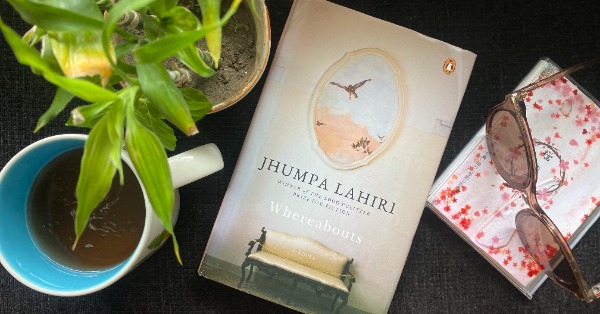
Whereabouts
Jhumpa Lahiri
Hamish Hamilton, Penguin Random House, Rs 499/-