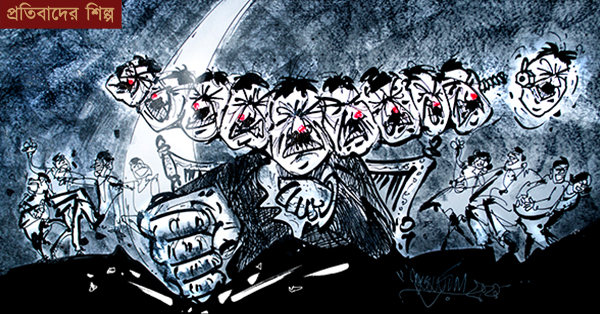

A judge walks out of his chambers laughing his head off. A colleague approaches him and asks why he is laughing. “I just heard the funniest joke in the world!” “Well, go ahead, tell me!” says the other judge. “I can’t – I just gave someone ten years for it!”
This is a classic political joke from Soviet Union. With Great Power comes Great Satire is a cultural understanding. From drawing a moustache on the photo of your building secretary who won’t let you play cricket to putting a razor to the Prime Minister’s beard, all of this is humour being used as a tool of opposition. Humour is a force. It is not violence, but it pricks. Power does not like jokes. A truly good joke makes power feel worthless. A bully does not like jokes; a strict teacher, your boss and even you don’t like it when a waiter taking your order at an expensive restaurant laughs at your pronunciation of ‘sesame’. It is like the rule of nature: if you hold power in the structure of society, a joke is going to burst your lovely colourful balloons. Someone you consider below you laughing at you probably makes you feel worse than losing the World War. Caste, class, gender, religion are some bases of power structures and oppression will result in protest disturbing those who enjoy the cream and the cake of power. Humour is a way of protest. Take this classic Russian joke:
A man was reported to have said: “Nikolay is a moron!” and was arrested by a policeman. “No, sir, I meant not our respected Emperor, but another Nikolay!” “Don’t try to trick me: if you say “moron”, you are obviously referring to our tsar!”
Classic. Applicable to all leaders (I hope we are thinking of the same leader). Jokes register protest and disagreement in a way that makes ‘power’ feel existential. ‘Power’ then asks itself “Am I what I think I am?” and as we all know ‘power’ hates questions. Hates questions to an extent where they don’t even address the nations questions and it’s going to be 7 years in power. A throwback to the CAA Protests. When the powers that be wanted to segregate our reality further on the grounds of religion we saw some hilarious lines coming out of our struggle: “Jab Hindu-Muslim raazi toh kya karega Nazi”, “Murga kaat ke khao Chicken Party, Bakra kaat ke khao Mutton party aur gareebon ka pet kaat ke khao toh Bhartiya Janta…”
We all know how the rule of three is going to go down here. I hope we do because having the ability to laugh is the ability to survive. German filmmaker Werner Herzog says, “If we do not develop adequate images we will die out like dinosaurs.” I believe the same applies for jokes.A society where humour is dying is one where even survival is about to get harder. In the Nazi regime, there were ‘Whisper Jokes’ which were jokes that could not be told in public because they criticized authorities. This happened because humour AKA resistance had to survive or else humanity would perish. So those cleaning the boots of “Fuhrer” with their tongues should be offended and their so-called ‘sentiments’ have to be hurt. If my joke is hurting your sentiments, it’s because our reality is hurting my sentiments. To paraphrase my need for jokes in these dark times, I’ll reside in the lines:
“Hai andheri raat par diya jalana kab mana hai…”
Any joke anyone cracks is to find the light at the end of the tunnel. To say funny people are mostly sad is not an exaggeration and it speaks volumes of how one rebels against its own self and to rebel against the powerful then comes more naturally. Not to say that the king’s jester is never funny. They are but they are not free people but that is a conversation to be had when the apocalypse comes and all of us talk of our regrets and the king’s jester will naturally have more. Or they won’t. All regimes have seen satire as an enemy and I hope the fascists never learn to laugh. If my thoughts feel all over the place, let me gather all of them for you in one joke.
The Führer visited a lunatic asylum. All the patients were told to stand in a row, and they were given instructions on how to salute him. When Hitler approached, they all raised their right hands and shouted: ‘Heil Hitler!’ Only the last man in the row uttered no sound and did not raise his hand. Red with rage, Hitler stepped up to him and shouted: “Don’t you know who I am? Why don’t you raise your hand?” “I beg your pardon,” replied the man politely, “I am the doctor. I’m not a lunatic’.