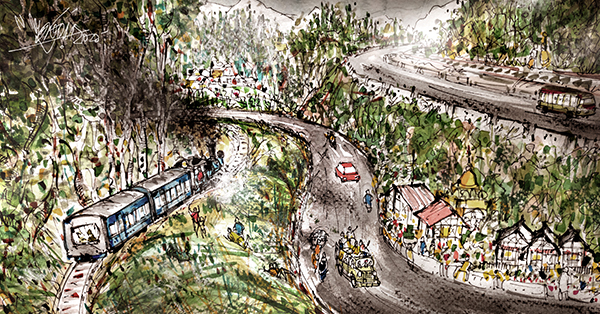

Hill Cart Road
Hill Cart Road was to our lives what the Grand Trunk Road was to our junior school history books – it was omnipresent. There were, after all, only two ‘roads’ in Siliguri town, and no matter where one went, one had to take one of the two. The other one was Sevoke Road, and because one end of the road was evident in the name – the fact that it ferried people between Siliguri and Sevoke – it wasn’t really worth our interest. To be completely honest, Hill Cart Road wasn’t called so by more than half of its residents. Rickshaw pullers in the 1980s and 90s, for instance, then one of the most important group of professionals in the town, called it Hill Cut Road. Who bothered about the names of roads, particularly at a time when Govinda and Johnny Lever were changing our vocabulary with their distortions and imaginative pronunciation of familiar Hindi and English words?
It didn’t really matter to us that it was the Hill Cart Road that took us to the Darjeeling mountains. We gave it as much – or little – respect as we did to the awareness of the forces of gravity that prevented us from falling when we walked or ran. This changed when I walked into Deshbandhu District Library in Darjeeling one afternoon. It was raining, and I, caught without an umbrella, walked in for shelter. What I discovered on its shelves, depleted as they looked from lack of funds and attention, was a dark brown-coloured book with an interesting subtitle: Darjeeling Letters 1839. But what was ‘The Road of Destiny’ in the title?
‘1839 was the most important year in the history of Darjeeling – the year the road which connected the hill station with the plains – its lifeline – was built. Right from the start it had been pointed out by the planners: No Road – No Darjeeling, and 1839 was the critical year when the decision was finally taken to go ahead with the plans. Over the year we see the beginnings of an embryonic settlement with a few stony paths, a few wattle and daub huts, and hundreds of people milling about like ants, reducing the jungle to building plots. We begin to distinguish the directors of all this activity, hitherto just names connected with the founding of Darjeeling, now taking on flesh and blood – Lloyd, Campbell, Wilson, Napier …’
I found this on the third page of Fred Pinn’s book. Before this was a brief history of the creation of sanatorium towns by the British in India, and Darjeeling in particular. As is well-known, the success of Cherrapunji, then in Assam, had made the ‘Government’ to ‘do something for the citizens of Calcutta and the Bengal Presidency’.
The two men credited with the ’discovery’ of Darjeeling are G. W. A Lloyd and J. W. Grant, who, in 1829, found ‘an old and deserted Gurkha military station – Dorje-ling or Darjeeling.’ There was much negotiation between the ‘Government’ and the Rajah of Sikkim, and this was followed by the stay of Colonel Lloyd and Dr. Chapman, the Governor-General’s bodyguard, for nine months as ‘guinea pigs’. Fred Pinn writes about the formation of the ‘Dorjeling Association of Calcutta’ and how Lt. Gilmore, an engineer, was posted at Darjeeling in June 1838 to ‘recruit a corps of sappers and miners partly for engineering work and partly as a defence force at the station’.
The two men credited with the ’discovery’ of Darjeeling are G. W. A Lloyd and J. W. Grant, who, in 1829, found ‘an old and deserted Gurkha military station – Dorje-ling or Darjeeling.’ There was much negotiation between the ‘Government’ and the Rajah of Sikkim, and this was followed by the stay of Colonel Lloyd and Dr. Chapman, the Governor-General’s bodyguard, for nine months as ‘guinea pigs’. Fred Pinn writes about the formation of the ‘Dorjeling Association of Calcutta’ and how Lt. Gilmore, an engineer, was posted at Darjeeling in June 1838 to ‘recruit a corps of sappers and miners partly for engineering work and partly as a defence force at the station’. Gilmore fell ill, and work hardly progressed, and so, in 1839, ‘an outburst of public indignation’ compelled the Government to intervene.
Fred Pinn collects the letters written to, from, and about Darjeeling in 1839, found in the archives of the Supreme Council of India, at their Calcutta office, the Council Chamber at Government House, and ‘the public correspondence sent to the main newspapers of the period’. I could not stop reading the letters. Not having a library card, I returned to the library the next day, so urgent was my need to discover the neglected history of people who had built the Hill Cart Road – its name literally meaning a ‘road’ built to ‘cart’ things to the ‘hills’. Not just the engineers and the workers who would eventually spend more than two decades to create Darjeeling, left invisible by history except for an occasional mention in a church register or a little-circulated bulletin, but the family they had left behind, in the plains of India, with their hostile heat, and those in England and other parts of Europe, waiting for them to return.
I will return to the letters in my next column, and, because of what is happening in Afghanistan at the moment, I will share with you the first editorial of 1839 (January 3) from The Friend of India. It is about Lord Auckland’s ‘disastrous foreign policy in Afghanistan’:
‘Another year of the history of British India has closed … The progress of a great change in the external policy of the Empire is plainly visible … Cabul, the key of India, was in the hands of those who were openly leagued with our Persian foes; and the commotion which had been thus been raised from the Caspian Sea to the Indus began to be felt in our own dominions in Hindoostan, and an impression of the insecurity of the British Empire in the East was beginning to gain ground … Shah Soojah is therefore to be restored to Cabul by a force nominally his own, but for all military purposes, British.’
So little has changed.
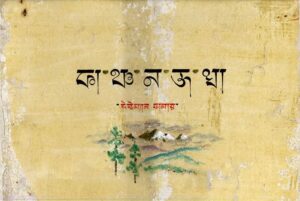
Illustration by Suvamoy Mitra